People throw “ghost kitchen” and “cloud kitchen” around like they mean the same thing. They don’t. This matters more than you think, especially if you’re considering sinking $20K to $100K into one. A ghost kitchen is your independent operation. A cloud kitchen is renting a station in somebody else’s building. One gives you brand equity and customer data. The other gives you a faster path to breakeven. Pick the wrong one and you’ll either bleed money on overhead or watch your brand get buried in facility politics. This post breaks down what actually separates them, the real numbers (including brutal CloudKitchens failure data), and a framework for deciding which model makes sense for your situation.
Defining the Terms (No Confusion)
Ghost Kitchen
A ghost kitchen is a commercial kitchen you lease or own, operating delivery-only with zero storefront. You own the brand. You control the menu. You manage the orders completely. All food gets made to order or prepped and packed for delivery through DoorDash, Uber Eats, Grubhub. You’re running a restaurant business, just without anyone walking through a door. Some operators run two, three, even four different brands simultaneously from the same ghost kitchen space. Different menus, different delivery listings, different customer bases, all from the same prep line. For the autopilot approach that runs review replies, Google posts, photo cadence, ranking audits, and the Maps grid scan in one subscription, see AI marketing autopilot for restaurants.

Cloud Kitchen
A cloud kitchen is a large commercial kitchen divided into multiple cooking stations, run by a facility operator (think CloudKitchens, Kitchen United, or local variants). You lease one station or prep area and operate your brand out of shared space, shared equipment, shared utilities. The operator manages the building, handles some logistics, and collects monthly rent from each brand. You’re independent, but dependent on facility hours, shared equipment, and whatever delivery system they’ve set up.
Dark Kitchen (The Umbrella Term)
Dark kitchen is a descriptor, not a business model. It just means “no customer-facing element, delivery-only.” A ghost kitchen is a dark kitchen. A station in a cloud kitchen is also a dark kitchen. Virtual restaurants (which we’ll get to) are dark kitchens. The term tells you how it operates, not who owns it or what the business model is.
Virtual Restaurant (The Hybrid)
A virtual restaurant launches from an existing location. Your established brick-and-mortar pizzeria adds a second brand (wings-only, salads, Asian) running from the same kitchen. MrBeast Burger did this brilliantly by partnering with existing ghost kitchen operators rather than building new facilities. You use existing infrastructure and customer relationships. It’s the lowest-risk model if you have an operating kitchen already, which most people don’t.
Side-by-Side Comparison

The Brutal Economics
Ghost Kitchen Math
Let’s be concrete. You’ll spend $20K-$50K to open a ghost kitchen in a secondary market (Austin, Nashville, Denver). That covers lease deposit, kitchen equipment, smallwares, initial inventory, licenses. In major metros (NYC, LA, SF), you’re looking at $50K-$100K or more because rent is higher and buildout is more expensive.
Monthly costs run $4K-$8K. In secondary markets, maybe $2.5K-$4K. Rent ($2K-$3K), utilities ($500-$800), insurance ($300-$500), supplies and smallwares ($500-$1K). Add delivery commissions on top of that.
Here’s where delivery apps bite you. DoorDash charges 15-30% commission depending on service level. Uber Eats takes 30% on most orders. Grubhub is similar. If your average order is $35 and you’re doing $50K in monthly revenue (roughly 1,450 orders), you’re paying $7,500-$15,000 in platform fees alone. That’s almost your entire rent right there.
Cloud Kitchen Math
Startup is cheaper. Move-in fee ($2K-$5K), initial inventory and smallwares ($4K-$7K), licenses. Maybe $10K-$12K total. That’s the appeal. You can test a concept without massive capital.
Monthly station rental runs $3K-$6K depending on market and facility quality. Add that 25% delivery commission hit (same problem as ghost kitchens), and you need $4K-$5K monthly in gross orders just to cover the station rental alone. Breakeven is faster on upfront cost, but your monthly commitment is similar.
The hidden cost: you don’t own your customer data. Most cloud kitchen operators aggregate orders through their system or delivery network. You never see customer emails, repeat order patterns, or phone numbers. If the facility shuts down (it happens), you lose the space and the customer data in the same event. When a ghost kitchen fails, you at least walk away knowing your customer names. When a cloud kitchen facility fails, you’ve got nothing.
What Actually Matters for Profitability
Brand Equity and Ownership
Ghost kitchens build equity. You own the brand, the reputation, the reviews, the customer loyalty. Over time, this becomes an asset. You can expand to second locations, franchise it, sell it. A ghost kitchen brand with strong reviews and social presence is worth something. A station in a facility? Not much, honestly. You’re replacing equipment and moving on.
Ghost kitchen and cloud kitchen are marketing terms for the same underlying concept: a delivery-only kitchen without a dining room. What matters isn’t the label, it’s the margin math and customer ownership strategy underneath.
This is where cloud kitchens have fundamental limits. You’re renting someone else’s assets. If the facility operator decides to promote a competitor’s brand more aggressively or raise your rent, you have limited bargaining power. We’ve seen cloud kitchen operators recruit direct competitors into the same facility (because they’ll pay similar rent). That’s not your problem to solve. You just lose customers.
Menu and Operational Flexibility
In a ghost kitchen, you pivot the menu tomorrow if you want. Test new items. Run limited-time offers. Adjust hours for demand. Change pricing. No approval required.
In a cloud kitchen, you work within facility constraints. Hours are fixed. Equipment availability might limit menu complexity. If the facility specializes in a certain cuisine type, they may actually discourage you from running something radically different because it creates workflow conflicts or health inspection complications.
Data as Competitive Advantage
Ghost kitchen operators who track repeat customers, know their preferences, and email them about specials have a profitability edge. You can calculate customer lifetime value. You know who your best customers are. You can offer loyalty programs that drive reorders. That data advantage compounds. A customer who orders twice becomes a customer who orders 6 times.
In a cloud kitchen, you don’t have that. You see transaction volume, but not the person behind it. You can’t identify your repeat customers and thank them directly. You can’t build a personal relationship that drives loyalty. Your marketing is limited to being present on the facility’s platform or running paid ads.
The Failure Rates (Actual Data)
Both models have high failure rates, but the data tells different stories.
Kitchen United, the other major shared facility player, closed dozens of locations. They claimed to solve restaurant economics by sharing infrastructure. They didn’t. The company shut down operations in India after three years of losses, closed underperforming US locations, and scaled back expansion plans dramatically.
Why? The problem isn’t the kitchen. It’s the brand. If your delivery-only concept doesn’t resonate with customers, shared kitchen economics don’t fix it. You still need strong positioning, good food, reliable execution, and aggressive customer acquisition. A cheap kitchen doesn’t solve a weak concept.
Ghost kitchens have failure rates that are harder to track because they fail quietly. No facility operator publicizing losses. But the underlying reason is the same: most new delivery-only brands fail because operators underestimate operational complexity, don’t differentiate on menu, or can’t hit their order volume targets.
The Packaging That Changes Everything
This sounds small until you do it. Packaging is your only physical brand touchpoint. Most operators use generic containers and plastic bags. The ones that convert succeed.
Use branded packaging. A simple kraft box with your logo and a QR code for reordering. A handwritten thank-you sticker. Maybe a napkin with your brand colors. One operator on Reddit reported their reorder rate went from 18% to 31% after switching from generic containers to branded packaging with a “thanks for your order” handwritten sticker. That’s a 72% improvement in repeat orders from a packaging change alone.
Why? Because packaging is how your brand survives the journey. The food is in a box for 30 minutes. It arrives at the customer’s door. If the unboxing experience is thoughtful, they remember you. They reorder. They leave better reviews. They tell friends. If it’s generic and sloppy, they forget you existed the moment they close the door.
Which Model Works for Which Situation

Choose a Ghost Kitchen if:
Choose a Cloud Kitchen if:
The Friction Points That Cost You Money
Ghost Kitchen Problems
You’re locked in. Ghost kitchen leases run 3-5 years typically. If your concept doesn’t gain traction, you’re paying rent on space you don’t need. We’ve seen operators paying $4K/month on a kitchen doing $3K in revenue. That’s a death spiral.

Everything is your problem. Equipment breaks down? You fix it or replace it. Delivery app integration fails? You troubleshoot it. Health inspector finds an issue? You handle it. You need operational sophistication, capital reserves, and willingness to solve problems on your own 24/7.
Kitchen space in good locations is scarce. You’re competing with established pizza shops, wings joints, and other ghost kitchens for the same real estate. If you’re in a high-demand area, you’ll overpay for space. If you’re in a lower-demand area, you’ve got fewer local customers to deliver to.
Cloud Kitchen Problems
Facility operators have conflicting incentives. They want you to succeed (you pay rent). They also want to fill all their stations (to maximize revenue). If they have capacity, they recruit your direct competitor. Your success gives them a bargaining position to raise your rent next renewal.
You lose control over your primary customer touchpoint. The facility operator controls the primary listing, how your orders are presented, delivery routing. If they decide to promote competing brands more aggressively or shuffle the app display, you have zero recourse. You’re dependent on their prioritization.
Facility failure is catastrophic. If the operator goes bankrupt or the facility closes, you lose your kitchen space and your customer data in the same event. You’re forced to find new space immediately, often at premium rates, just to keep operating. Some operators have reported getting 30 days notice before the facility shut down. Good luck sourcing a new kitchen and moving prep operations in that timeframe.
The Marketing Reality Nobody Mentions
Both models have a marketing problem that traditional restaurants don’t face. You have no storefront. No passersby. No sign visibility. All your customer acquisition happens digitally.
For ghost kitchens, that means building brand awareness from zero. You need strong delivery app optimization (professional photos, descriptions, correct menu pricing). You need social media presence (TikTok and Instagram where food content goes viral). You need Google Business Profile setup (yes, you can have one without a dine-in location). Most ghost kitchen failures happen because the food is good but nobody knows they exist.
For cloud kitchens, marketing is partially handled by the facility operator, but don’t rely on that. Their incentive is facility occupancy, not your brand success. You still need your own marketing engine. The advantage is you can test different concepts faster. Run a taco brand, a wings brand, a pasta brand from the same station. See which one resonates with customers and get traction, then optimize around the winner.
Delivery app ranking matters enormously. Your position in DoorDash, Uber Eats, and Grubhub search results determines 70-80% of your order volume. That ranking depends on your photos (professional photos increase orders 25-30%), response time, reviews, and promotion participation. Treat delivery app optimization like traditional restaurants treat local SEO. It’s your equivalent of being on page one of Google.
Budget 15-20% of projected revenue for marketing in the first six months. That’s higher than a traditional restaurant because you have no organic foot traffic. If you can’t afford that spend, you’re joining the majority that doesn’t survive the first two years.
Decision Framework: Ask Yourself These Questions
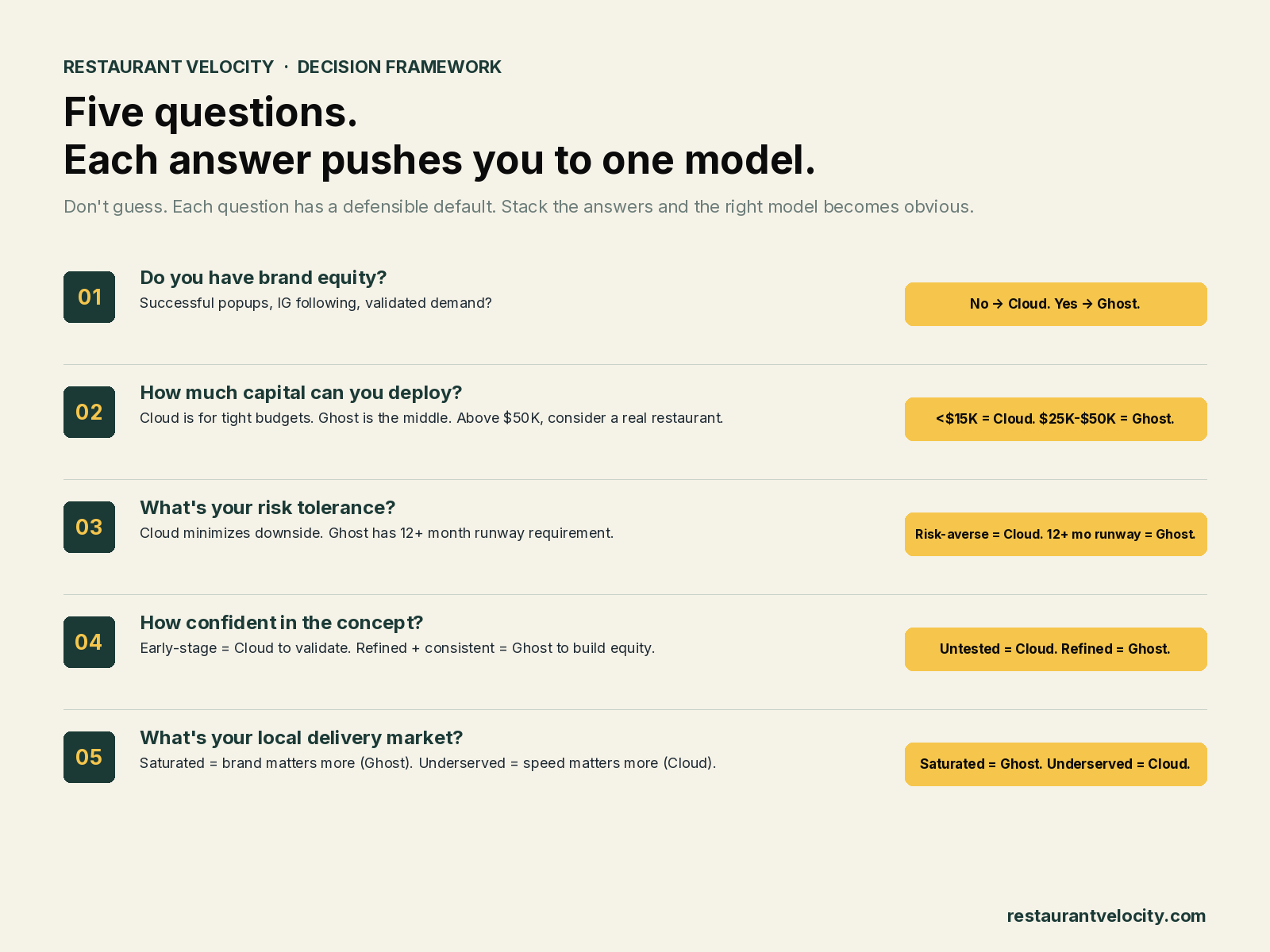
- Do you have brand equity? Successful popups, Instagram following, validated customer demand. If no, start with a cloud kitchen. If yes, ghost kitchen capital requirements are justified.
- How much capital can you deploy? Less than $15K? Cloud kitchen. $25K-$50K? Ghost kitchen is viable. More than $50K? Consider a small traditional restaurant instead.
- What’s your risk tolerance? Can’t afford to lose $20K-$30K? Cloud kitchen is safer. Have 12+ months runway? Ghost kitchen upside is worth the risk.
- How confident are you in the concept? Early-stage, untested idea? Cloud kitchen to validate demand. Refined concept with consistent execution? Ghost kitchen to build equity.
- What’s your local delivery market? Saturated with competitors? You need strong branding and customer loyalty. Underserved niche? Cloud kitchen speed to market might matter more than brand ownership.
FAQ
Are ghost kitchen and cloud kitchen the same thing?
No. Ghost kitchens are independent operations where you lease or own your dedicated space. Cloud kitchens are shared facilities where you rent a station from an operator. Both are delivery-only, but the business models are fundamentally different. Ghost kitchens offer brand control and long-term equity. Cloud kitchens offer lower startup cost and faster breakeven. The gap widens over time.
What’s the difference between a ghost kitchen and a dark kitchen?
Dark kitchen describes the operational characteristic: no storefront, no dine-in, no walk-ins, delivery-only. Ghost kitchens are dark kitchens. Cloud kitchen stations are also dark kitchens. Virtual restaurants from existing locations are dark kitchens. The term tells you how it operates, not who owns it or what the business model is.
How much does a ghost kitchen cost to start?
Startup costs range from $20K to $100K. Secondary markets are typically $20K-$50K. Major metros are $50K-$100K or more. That includes lease deposit ($3K-$8K), kitchen equipment ($8K-$30K), smallwares and initial inventory ($3K-$10K), licenses and insurance ($2K-$5K). Specialized cuisines like pizza or sushi cost more because of equipment requirements. Simple concepts like sandwiches or bowls cost less.
How much does a cloud kitchen cost to start?
Startup is typically $8K-$15K including move-in fee ($2K-$5K), smallwares ($2K-$4K), initial inventory ($2K-$4K), and licenses. Monthly station rental then runs $3K-$6K depending on facility and market. The lower upfront cost is the main appeal, but your monthly commitment is similar to a ghost kitchen’s rent, so long-term costs converge over time.
What profit margins are realistic?
Both models can achieve 15-25% net profit margins if execution is strong. Reality: most operators achieve 5-15% because they underestimate food costs, delivery commissions crush them, and they’re not tracking unit economics. Ghost kitchens have a slight long-term advantage because you own customer data and can optimize for repeat orders. Cloud kitchens have margin pressure because you share facilities with competitors and have less control over the customer relationship. The difference matters after year two.
How long does it take to break even?
Ghost kitchens typically break even in 6-18 months. Cloud kitchens can break even faster (2-6 months) because of lower upfront cost, but monthly rent commitment is similar, so you still need 150-200 daily orders to sustain operations. Breakeven depends heavily on your concept’s appeal, marketing execution, and ability to hit order volume targets. Don’t assume faster breakeven if your concept is weak.
Can I operate multiple brands from one ghost kitchen?
Yes. Many operators run 2-4 brands from the same space with separate menus and delivery app listings. Requires strong operational discipline and enough kitchen hours to handle multiple brands’ prep and service times. Works best with complementary cuisines (Italian and pizza, for example) rather than competing concepts. Watch for cannibalization where customers choose one brand over another instead of ordering from both.
What happened to CloudKitchens and Kitchen United?
CloudKitchens (backed by Uber founder Travis Kalanick) expanded aggressively but faced a 65% annual tenant turnover rate. That means two out of three brands fail or leave each year. Kitchen United closed dozens of locations and pulled out of markets like India after years of losses. Both companies are still operating but at much smaller scale with more realistic growth expectations. The lesson: shared kitchen facilities don’t automatically create successful restaurant businesses. Most tenants fail because they underestimate operational complexity or lack competitive positioning.
Should I choose a ghost kitchen or cloud kitchen if I’m new to restaurants?
If you’re genuinely new, start with a cloud kitchen. Lower upfront cost, faster learning curve, easier exit if you discover the model isn’t for you. If you have 3+ years of restaurant experience in FOH or BOH, a ghost kitchen is viable if you have sufficient capital and a validated concept. Don’t attempt a $50K ghost kitchen as your first restaurant operation with untested ideas. The operational challenges and cash burn will overwhelm you.
What kills delivery-only restaurants most often?
Menu that doesn’t travel well (foods that get soggy, dishes that need to be served hot within seconds). Weak positioning (another pizza place in a market with 20 pizza places). Poor marketing (nobody knows you exist). Bad packaging (generic containers that don’t communicate your brand). Underestimating delivery commission impact (30% off the top changes the entire unit economics). Not tracking which menu items are actually profitable. Weak execution or inconsistent quality. None of these are about the kitchen model. They’re all about the brand and operations.
Want to skip the manual workflow and run all eight workflows on autopilot? Start the free trial of Restaurant Velocity, the AI marketing autopilot for restaurant operators.
The Bottom Line
Ghost kitchens and cloud kitchens are fundamentally different models with different risk profiles and payoff structures. Ghost kitchens are for building long-term brand equity with higher capital requirements upfront. Cloud kitchens are for testing concepts with lower risk and faster learning. Neither solves the core problem: launching a delivery-only restaurant is hard. Delivery commissions kill margins. Customer acquisition costs are high. Failure rates are high because most operators underestimate operational complexity and market saturation.
The model matters less than execution. Pick the one that aligns with your capital, timeline, and risk tolerance. Then focus on the real work: building a brand customers actually want to order from repeatedly. That’s where winners emerge. That’s where profitability lives. The kitchen is just the building. Your brand is the business.
Ready to build a delivery-only restaurant that actually works?
The difference between ghost and cloud kitchens matters, but execution matters more. Learn the marketing strategies and operational tactics that drive consistent orders and customer retention.