
Marketing teams put 19.4 percent of their budget into software in 2026, the lowest share in five years, while 62 percent said they planned to spend more.
That number comes from Gartner’s 2026 CMO Spend Survey, 401 respondents, fielded January to March 2026 and reported by Chief Marketer on June 24. It is also useless to you, and I want to get that out of the way in the first paragraph rather than the eighth. Gartner surveys companies above a billion dollars in revenue. You run a restaurant.
Second thing to get out of the way. We sell software in this category. Restaurant Velocity is a Google Business Profile app, so when I tell you a software line item is legitimate, you should discount that the way you would discount a POS rep telling you your POS is too old. What is worth saying is that ten of the twelve pages currently ranking for this question also sell the thing they are telling you to fund, and not one of them says so. Four are software vendors, three are agencies, three are AI tool startups. The loyalty vendor tells you to budget for loyalty. The ordering vendor tells you to budget for ordering.
The top-voted comment on a 79-comment restaurant software thread in r/restaurantowners this month was not an argument about price or features. It was “this is one hundred percent a setup post for SaaS marketing / move on everybody”, 15 upvotes, posted 2026-09-09. Fifteen upvotes is not a lot in absolute terms. It being the single highest-voted sentiment in the thread is the part that matters.
The percentage every budget article gives you, and why no operator uses it
Here is what I found when I went looking for the answer to this question the honest way. Twelve pages rank for it. Roughly 27,000 words between them. Not one states what share of a restaurant marketing budget should go to software.
They all answer the easier adjacent question instead: what percent of revenue goes to marketing. And the answer they give, “3 to 6 percent established, 7 to 8 percent in growth mode, 8 to 15 percent for a new opening,” appears on nine of the twelve with no study attached to any of them. I could not trace it to an original source. It is folklore that got repeated until it acquired the texture of data.
Worse, it does not describe what operators do. Read how restaurant owners talk about marketing money in their own threads and the pattern is immediate: nobody uses percentages. They use absolute monthly dollars, attached to a specific job.
A new single location gets told to spend 5 to 10 dollars a day on tight-radius Meta video, which is 150 to 300 a month. One operator reported 500 a month on hyper-local Roku ads and “almost 1k hits nightly.” Influencers came up at 600 to 1,200 an engagement. One owner said plainly, “I own a restaurant. I had been working with a sm manager, $1700/mo, for 6 months,” and mentioned she had given notice to two other social media managers before that one.
Stack those real line items into a month and you get something that looks nothing like the folklore. An operator running Meta plus occasional content, no hired help, is at roughly 200 a month. One funding a second channel is at 900. One paying a social media manager on top is at 2,600. On a 1.2 million dollar restaurant those are 0.2 percent, 0.9 percent and 2.6 percent of revenue.
Every one of them is below the 3 percent floor that nine pages call the minimum. The benchmark is not a benchmark. It is a number that flatters the people selling against it.
What a software share actually works out to for one restaurant
So no survey gives us the number. Fine. We can derive it, show the arithmetic, and label it as derived, which is different from what everyone else on this page is doing, which is asserting.
Take a representative unit: one location, 60 seats, roughly 2,940 covers a month at a 34 dollar average check, so about 1.2 million dollars a year. Two routes.
Route one comes down from Gartner. If software is 19.4 percent of a marketing budget, apply that share to the three real operator budgets above. The 200 dollar month allows 39 dollars of software. The 900 dollar month allows 175. The 2,600 dollar month allows 504. That is the whole calculation, and the reason to trust the ratio more than the base is that the ratio is what Gartner actually measured.
Route two comes down from restaurant technology spending instead. Hospitality Technology’s 2026 Restaurant Technology Study puts restaurant IT budgets at 2.58 percent of revenue, with 66 percent of that going to maintaining systems already in place. On 1.2 million dollars that is 2,580 a month of IT, of which roughly 877 is discretionary. But that 877 is not marketing’s money. It competes with POS add-ons, kitchen display, network, back office, scheduling. Marketing software is one of about five claims on it, which puts it near 175 a month.
Two unrelated proxies, one from enterprise marketing and one from restaurant IT, landing on the same 175 dollars.
I want to be careful about how much weight that carries. Two rough approximations agreeing is suggestive, not proof. The “one of five claims” split is my assumption, not a survey finding. The Hospitality Technology figure was confirmed through that page’s search index rather than read off the study PDF, so treat it as strong but not primary. And the Gartner ratio was measured on billion-dollar companies, which is exactly the objection I raised against it in the intro and it does not stop being true because the answer came out convenient.
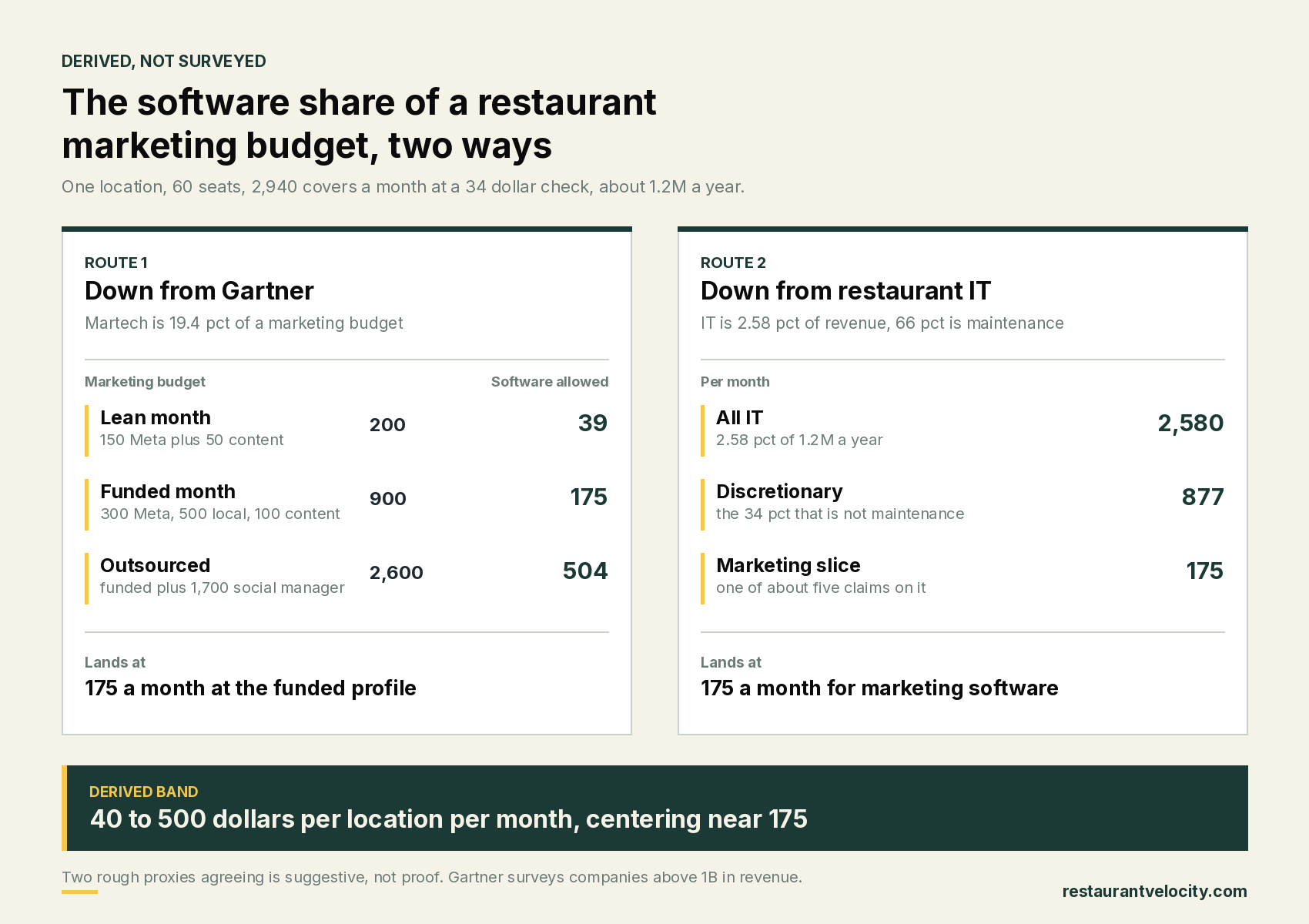
With those caveats stated, the derived band is 40 to 500 dollars per location per month, centering near 175, and what moves you inside that band is not your revenue. It is whether you are paying a human. That is the finding I did not expect going in.
If you want the top-line number that sits above this one, our restaurant marketing budget guide works the whole budget from covers rather than from a percentage. This page is only about the software line inside it.
The threshold that matters more than the percentage
Now the part that actually decides this, and it did not come from us.
An operator in r/restaurantowners wrote the best objection to software spending I have read anywhere, on 2026-05-18:
“I understand the resistance to this sort of stuff as a small outfit because the cost of creation and maintaining these systems is often a larger percentage of revenue than the benefit is and the operation is small enough for a disciplined leader to focus on.”
Read that again, because it is not the objection vendors prepare for. It is not “software is too expensive.” It is “software replaces attention I am already paying for free.” At one location, with an owner on the floor, that is correct. I am not going to argue with it, and any page that does is selling.
Then the same commenter, unprompted, hands over the other half:
“But, a second location means it’s time for these systems to come in because even a disciplined leader can’t be in two places at once and delegation without an ‘overwatch’ system in place means problems are going to come up and won’t be noticed until it’s too late.”
Four months later a different operator described the same break point from the inside, on 2026-09-19: “What worked when I had one restaurant was manageable because I could keep an eye on everything myself. With two locations I need better visibility without constantly asking each manager for updates.”
Two operators, unconnected threads, four months apart, drew the line in exactly the same place. That convergence is worth more than any percentage, and it reframes the question. The honest answer to “what share should go to software” is not a share. It is a threshold, and there are three ways to cross it.
Unit count goes from one to two. This is the one the operators named. It is not about revenue doubling. It is that attention stops being divisible.
Review volume passes roughly 30 to 40 a month. Below that, replying inside the window that matters still fits into a shift. Above it, the replies either get batched two weeks late or they stop. We have said before that a single location under 30 to 40 reviews a month should not buy this category, and I will say it again here even though it costs us.
Someone else is publishing and you are not seeing it. The first time a manager posts to the Google profile and the owner finds out later, the overwatch problem has arrived, regardless of unit count.
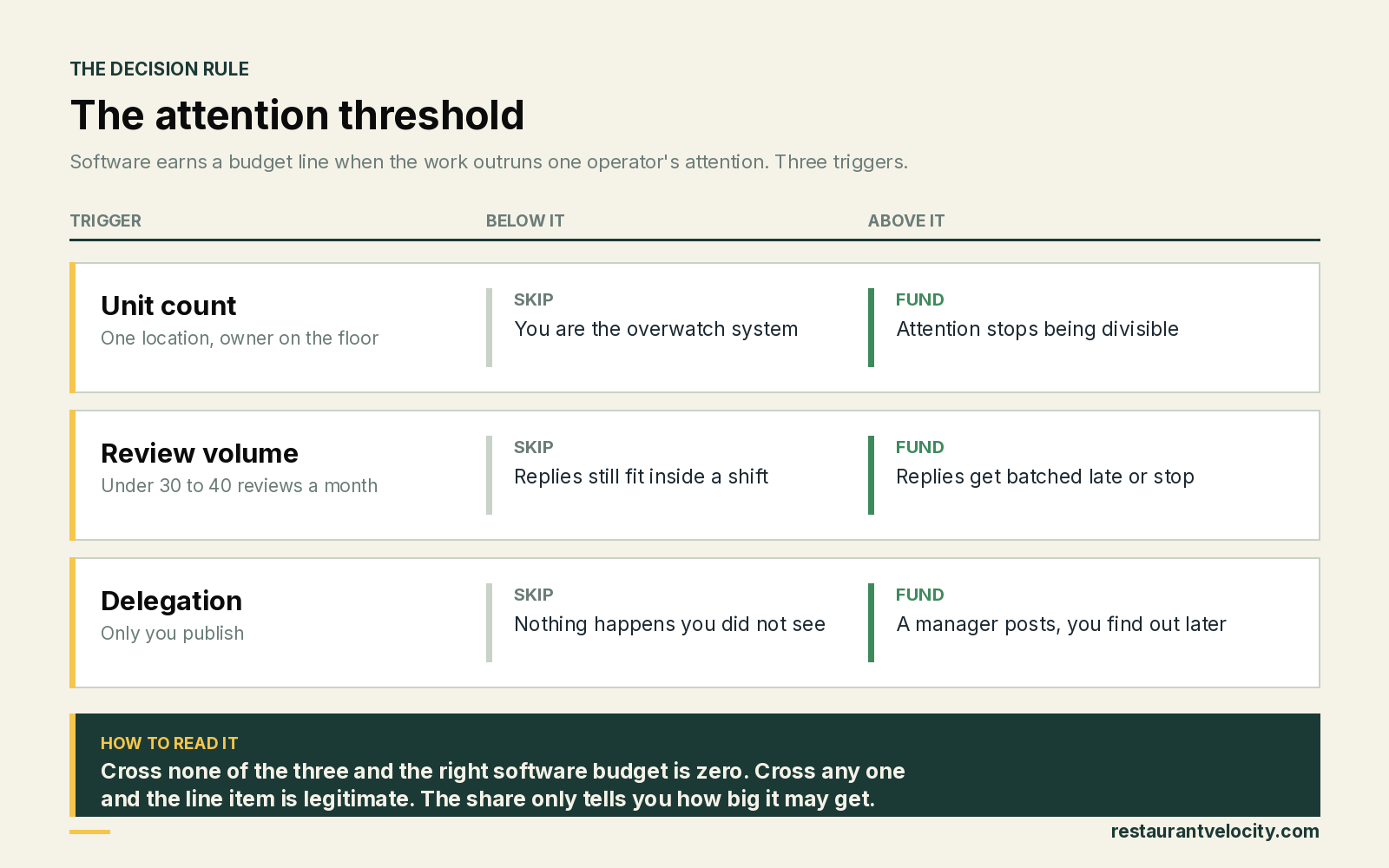
Cross none of the three and the right software budget is zero. Keep the money. Cross any one and the line item is legitimate, and the derived band from the last section tells you roughly how big it is allowed to get.
Price your own hours or the math is fiction
There is a question one of the twelve ranking pages actually asks: should I include the cost of my own time in the marketing budget? It asks it and then does not answer it with a number. So here is the number.
Value operator time at 28 dollars an hour. That is not a wage, it is what an hour of owner attention is worth against the next thing it could be doing, and it is the rate we use across our own models so the comparisons stay consistent.
Google Business Profile work on a single restaurant runs 4 to 6 hours a week once you include review replies, the weekly post, photo uploads and checking why the place two blocks over outranks you. That is 17 to 26 hours a month. At 28 dollars an hour, the free path costs 485 to 728 dollars a month in owner attention.
Which means a tool at 50 dollars a location has to save you about 1 hour and 47 minutes a month to break even on time alone. Roughly 25 minutes a week. At 99 dollars it needs 3 hours and 32 minutes. At the full 175 dollar derived budget, 6 hours and 15 minutes, which is about 1 hour 27 minutes a week.
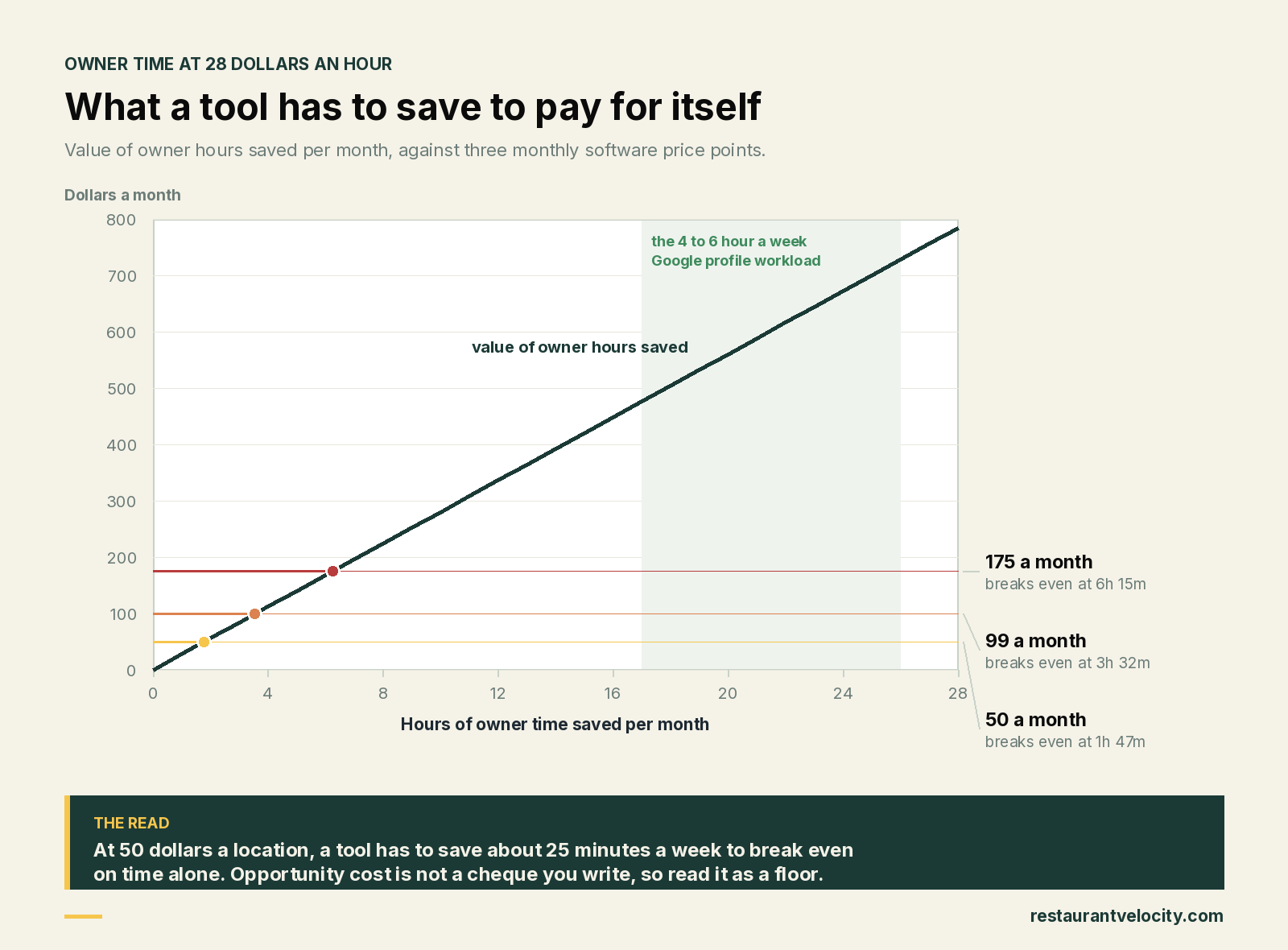
Now the caveat that most versions of this argument skip, and skipping it is how the argument becomes dishonest. Opportunity cost is not a check you write. If your Tuesday at 3pm has nowhere more valuable to go, those hours are genuinely cheaper than the subscription, and choosing them is not a mistake. It is a correct reading of your own constraint. The operator who said the small outfit is better off with a disciplined leader is describing precisely this, and he is right up until the hour he needs is an hour he does not have.
The number changes only when the hour has somewhere better to be. That is the same threshold as the last section, priced.
The 2026 line items, priced as honestly as anyone can price them
I went to check 2026 prices for every category an operator actually funds. Most of what is written about this online is not checkable, and the reason is simple.
GatherUp publishes its price: 99 dollars a month for one location, 60 dollars a location on multi-location tiers, 40 a location for the listings add-on, 14-day trial. That is on their pricing page, verified 2026-09-21.
Birdeye publishes no price. Podium publishes no price. Their pricing pages carry customer results and a contact form. So every “Birdeye costs X” number circulating out there is somebody’s guess, which is why I found Birdeye quoted at 250, at 299, at 299 to 449 and at 299 to 499 across four different sites in one afternoon. Those sites are near-certainly AI-generated affiliate pages. Nobody knows, including the people publishing the numbers with confidence.
When a vendor hides price, the price is a function of how the call goes.
On funding order, three adversarial sources agree, which almost never happens. An operator with no product to sell, a marketer advising an operator, and a consultant selling AI tools all put the Google Business Profile first. One of them added, about fixing a profile for the Gemini shift in Maps, “None of it is complicated or costly”, 11 upvotes. That is an argument against paying anyone for it, sitting inside the same evidence that says to do it first, and both halves are true. It is not complicated. It is relentless, which is a different problem.
Fund in this order and stop when the money runs out: the Google profile, then review response, then whatever channel your own guests actually come from, then email, then everything else. Loyalty and ordering platforms are real products, and they are also the categories marketed at you hardest relative to what they return at one location. If you want the full priced version, our AI marketing stack for independent operators builds a named stack line by line, and the AI tools for restaurant Google Business Profile shortlist compares six of them with us as one row rather than the only row.
Ours, since you are entitled to it in the same paragraph as everyone else’s: Restaurant Velocity is 50 dollars per location per month. That is a founding price for the first 50 customers and it stays locked for as long as you stay, after which the standard rate is 99 per location. One price per location, so three locations is 150. All eight workflows are included at every location with no tiers and no feature gates: review replies in your own voice, Instagram and Facebook comment replies, weekly Google posts, a scored and captioned photo library, a 38-factor profile audit, the local rank grid, competitor tracking, and Manual, Assist or Auto control modes set separately per workflow. Fourteen day free trial, nothing charged until day 15, no contract. Start your 14-day free trial if the threshold section said you are above the line. If it said you are below it, do not.
The pricing trap that wrecks a 2026 software budget
This is the section none of the twelve ranking pages has, and it is the one most likely to cost you money this year.
In the same Gartner survey, 56 percent of marketing organizations moved more of their software budget onto consumption-based pricing over the past year, against only 9 percent that moved away from it. Half of the organizations using consumption-priced software are, in Gartner’s description, continually renegotiating contracts to stop usage and cost spikes.
Read that as an operator. The billing model for AI-heavy software is drifting from a flat monthly fee to a meter. A meter does not appear in a forecast. You budget 200 a month, the tool has a good month, and the invoice is 340.
It is not a scam and it is not new. Your credit card processing has always worked this way. What is new is the meter arriving in the line item you were treating as fixed, in the same year that AI-native software spending jumped 108 percent year over year across the enterprises Zylo tracks. Four questions before you sign anything:
- Is the price flat per location, or metered? If metered, metered on what unit, exactly?
- What did a customer like me pay last month, not what does the plan start at?
- What happens on the month a review goes viral and volume triples?
- Is there a cap, and if there is not, why not?
A vendor who cannot answer the second question with a number has told you something.
When to cancel, and the four questions that decide it
The useful thing about cancellations is that operators explain them, and the explanations do not match what the pricing pages assume.
Three documented cases from the research. A local SEO subscriber cancelled over a 5 dollar add-on, writing “I wasn’t getting much value from the tool and had to cancel my subscription”, and four days later noted it had taken 25 days to get a Google post scheduler working. A multi-unit group described its back-office platform as “basically abandon-ware, at this point, and we’re working up the courage to jump, before it fails” after an acquisition took the engineers. And an operator paying for a platform specifically to consolidate vendor invoices found himself downloading CSV files by hand: “I thought the reason people spent the money on r365 was because it did that for you.”
Price triggered none of them. In the same corpus, an operator called 3 dollars a location for a reputation platform “an absolute steel.” The 5 dollar add-on lost a whole subscription and the 3 dollar one earned praise, which tells you the monthly figure is not what operators are actually evaluating.
So the audit is four questions, run on every marketing subscription once a quarter. It takes about twenty minutes.
- Did I log in last month? Not “do I have access.” Did I open it.
- Which specific job does it do that would otherwise land on a person, and how many hours is that job?
- Is the vendor still shipping, or has it gone quiet since the acquisition?
- If I cancelled today, what do I lose that I cannot get back?
That last one is the cheapest insurance in the list. One operator described handing over creative assets and losing access on exit. For what it is worth, everything we publish to a Google profile stays there if you cancel, because it belongs to the restaurant, and any vendor in this category should be able to say that sentence without qualifying it.
The most instructive case in the whole research was not a cancellation. An operator spent two weeks evaluating the market, took calls with a long list of vendors, and bought nothing. His reason: “Instead of trying to see what I need, they try to sell what features they’ve built”, and separately, being “bloated with features that i’ll never use is not something i’d want to put my money in.” We ship eight workflows, so that criticism has our name on it too. Eight workflows on one profile is not the same shape of problem as eight products, but make us prove that inside the trial rather than taking it from a blog post.
If the threshold says you are above the line and the audit says your current stack is not earning it, that is the moment the switch is worth the friction. See Restaurant Velocity pricing, or read what actually breaks after you buy, which is the less flattering companion to this page and includes four of our own bugs with the numbers attached.


